You cannot select more than 25 topics
Topics must start with a letter or number, can include dashes ('-') and can be up to 35 characters long.
 Gerardo Marx
dc2cf45b10
Gerardo Marx
dc2cf45b10
|
2 years ago | |
|---|---|---|
| Readme_files | 2 years ago | |
| .gitignore | 2 years ago | |
| Readme.md | 2 years ago | |
| main.ipynb | 2 years ago | |
Readme.md
#!pip3 install tensorflow
import tensorflow as tf
import numpy as np
import matplotlib.pyplot as plt
# data for training the ann mode
# option 1:
celsius = np.array([-40, -10, 0, 8, 15, 22, 38], dtype=float)
fahrenheit = np.array([-40, 14, 32, 46, 59, 72, 100], dtype=float)

# option 2: (X°C x 9/5) + 32 = 41 °F
points = 100
np.random.seed(99)
dataIn = np.linspace (-40,60, points)
target = dataIn*9/5 + 32 +4*np.random.randn(points)

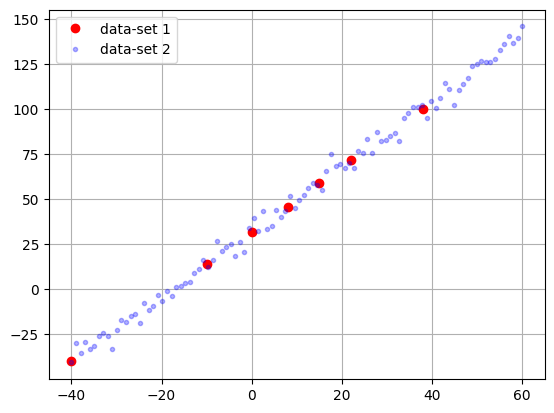
plt.plot(celsius, fahrenheit, 'or', label='data-set 1')
plt.plot(dataIn, target, '.b', alpha=0.3, label='data-set 2')
plt.legend()
plt.grid()
plt.show()
from tensorflow.keras.models import Sequential # ANN type
from tensorflow.keras.layers import Dense, Input # All nodes connected

# NN definition
hn=2
model = Sequential()
model.add(Input(shape=(1,), name='input'))
model.add(Dense(hn, activation='linear', name='hidden'))
model.add(Dense(1, activation='linear', name='output'))
model.summary()
Model: "sequential_1"
┏━━━━━━━━━━━━━━━━━━━━━━━━━━━━━━━━━┳━━━━━━━━━━━━━━━━━━━━━━━━┳━━━━━━━━━━━━━━━┓
┃ Layer (type)                    ┃ Output Shape           ┃       Param # ┃
┡━━━━━━━━━━━━━━━━━━━━━━━━━━━━━━━━━╇━━━━━━━━━━━━━━━━━━━━━━━━╇━━━━━━━━━━━━━━━┩
│ hidden (Dense)                  │ (None, 2)              │             4 │
├─────────────────────────────────┼────────────────────────┼───────────────┤
│ output (Dense)                  │ (None, 1)              │             3 │
└─────────────────────────────────┴────────────────────────┴───────────────┘
Total params: 7 (28.00 B)
Trainable params: 7 (28.00 B)
Non-trainable params: 0 (0.00 B)
### veri important note implement a python code
# to show the ANN model connection using ascii
from tensorflow.keras.optimizers import Adam

#hyper parameters
epoch = 500
lr = 0.01
hn = 2 # hidden nodes
tf.random.set_seed(42)  # For TensorFlow


model.compile(optimizer=Adam(lr), loss='mean_squared_error')
print("Starting training ...")
historial = model.fit(dataIn, target, epochs=epoch, verbose=False,)
print("Model trainned!")
Starting training ...
Model trainned!
predict = model.predict(dataIn)
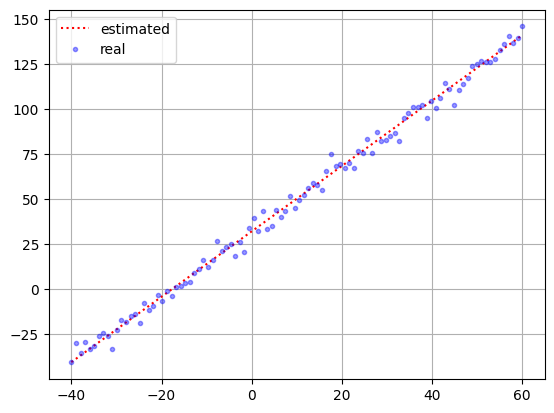
plt.plot(dataIn, predict, ':r', label='estimated')
plt.plot(dataIn,target, '.b', label='real', alpha=0.4)
plt.legend()
plt.grid()
plt.show()
[1m4/4[0m [32m━━━━━━━━━━━━━━━━━━━━[0m[37m[0m [1m0s[0m 4ms/step
# Get weights
for layer in model.layers:
    weights = layer.get_weights()
    print(f"Layer: {layer.name}")
    print(f"  Weights (Kernel): {weights[0].shape} \n{weights[0]}")
    print(f"  Biases: {weights[1].shape} \n{weights[1]}")
Layer: hidden
  Weights (Kernel): (1, 2)
[[-0.27738443  0.7908125 ]]
  Biases: (2,)
[-8.219968  6.714554]
Layer: output
  Weights (Kernel): (2, 1)
[[-1.9934888]
 [ 1.5958738]]
  Biases: (1,)
[5.1361823]
Testing the model
inTest = np.array([100])
model.predict(inTest)
[1m1/1[0m [32m━━━━━━━━━━━━━━━━━━━━[0m[37m[0m [1m0s[0m 87ms/step
array([[213.73816]], dtype=float32)
# Do the Maths:
inTest = np.array(inTest)
whi = np.array([[-0.27738443, 0.7908125 ]])
bh = np.array([-8.219968, 6.714554])
Oh = np.dot(inTest,whi)+bh
who = np.array([[-1.9934888],[ 1.5958738]])
bo = np.array([5.1361823])
Oo = np.dot(Oh,who)+bo
Oo
array([213.73814765])
def generate_ascii_ann(model):
    ascii_diagram = "\nArtificial Neural Network Architecture:\n"

    for i, layer in enumerate(model.layers):
        weights = layer.get_weights()

        # Determine layer type and number of neurons
        if isinstance(layer, Dense):
            input_dim = weights[0].shape[0]  # Number of inputs
            output_dim = weights[0].shape[1]  # Number of neurons

            ascii_diagram += f"\nLayer {i+1}: {layer.name} ({layer.__class__.__name__})\n"
            ascii_diagram += f"  Inputs: {input_dim}, Neurons: {output_dim}\n"
            ascii_diagram += f"  Weights Shape: {weights[0].shape}\n"

            if len(weights) > 1:  # If bias exists
                ascii_diagram += f"  Biases Shape: {weights[1].shape}\n"

            # ASCII representation of neurons
            ascii_diagram += "  " + " o " * output_dim + "  <- Output Neurons\n"
            ascii_diagram += "   |   " * output_dim + "\n"
            ascii_diagram += "  " + " | " * input_dim + "  <- Inputs\n"

    return ascii_diagram

# Generate and print the ASCII diagram
ascii_ann = generate_ascii_ann(model)
print(ascii_ann)
Artificial Neural Network Architecture:

Layer 1: hidden (Dense)
  Inputs: 1, Neurons: 2
  Weights Shape: (1, 2)
  Biases Shape: (2,)
   o  o   <- Output Neurons
   |      |
   |   <- Inputs

Layer 2: output (Dense)
  Inputs: 2, Neurons: 1
  Weights Shape: (2, 1)
  Biases Shape: (1,)
   o   <- Output Neurons
   |
   |  |   <- Inputs
graph LR
I1((I_1)) --> H1((H_1))  & H2((H_1))
H1 & H2 --> O1((O_1)) & O2((O_2))